45 coupon vs zero coupon bonds
Zero Vs Fixed Coupon Bond volatility | QuantNet Community Everywhere I look for this on the internet I read that Zero Coupon Bonds are more volatile than Fixed Coupon Bonds. The explanation for this seems to be that the Duration (both Macaulay and Modified) are larger the lower the size of the coupon is, and consequently a, let's say 10Y ZC Bond has a larger duration than a 10Y 5% Coupon Bond. Deep Discount bonds and Zero Coupon Bonds - The Fixed Income A cumulative product provides clarity of coupon paid. The taxation of the returns depends on the tax treatment prescribed at the time, varying from being taxed at maturity or on the accrued interest being taken up for tax in the year it is earned. Another avatar of the deep discount bond is the zero-coupon bond (ZCB).
Should I Invest in Zero Coupon Bonds? | The Motley Fool So for instance, a 10-year zero coupon bond priced when prevailing yields were 3% would typically get auctioned for roughly $750 per $1,000 in face value. The $250 difference would essentially...

Coupon vs zero coupon bonds
What is the difference between a zero-coupon bond and a regular ... - Quora The difference between a regular bond and a zero-coupon bonds, is that the former pays bondholders interest, while the latter does not issue such interest payments, otherwise known as coupons. Instead, zero-coupon bondholders merely receive the face value of the bond when it reaches maturity, while coupon paying bondholders receive both the face value, while also receiving coupons, over the life of the bond. Zero-Coupon Bond: Formula and Excel Calculator In contrast, for zero-coupon bonds, the difference between the face value and the bond's purchase price represents the bondholder's return. Due to the absence of coupon payments, zero-coupon bonds are purchased at steep discounts from their face value, as the next section will explain more in-depth. Zero-Coupon Bond - Bondholder Return Discount bond vs. Zero coupon bond : personalfinance - reddit They're all colloquialisms that change with time. But yea, hes wrong. Discount means trading at a discount (less than face value), zero coupon is exactly that, no coupons (like treasuries) A discount bond is just a bond that sells/trades at a discount to par value. Your economics professor is incorrect.
Coupon vs zero coupon bonds. Zero Coupon Bond Funds: What Are They? - The Balance A zero coupon bond is a bond that doesn't offer interest payments but sells at a discount—a price lower than its face value. 1 The bondholder doesn't get paid while they own the bond, but when the bond matures, they will be repaid the full face value. Zero coupon bond funds are funds that hold these types of bonds. Zero-Coupon Bond - Definition, How It Works, Formula As a zero-coupon bond does not pay periodic coupons, the bond trades at a discount to its face value. To understand why, consider the time value of money. The time value of money is a concept that illustrates that money is worth more now than an identical sum in the future - an investor would prefer to receive $100 today than $100 in one year. Zero-coupon bond - Bogleheads Zero-coupon bonds or "zeros" result from the separation of coupons from the body of a security. Consequently, from a single coupon-paying bond, two bonds result: one which pays the coupons but returns no principal at maturity (an annuity), and one which pays no coupons but returns the par value at maturity (a zero-coupon bond). Zeroes sell ... What are Zero Coupon Bonds? Explain some of its variants. Zero-coupon bonds (ZCB), also known as deep discount bonds do not carry any coupon rate. They are issued at a discount and redeemable at par. The amount of discount is equal to the total return for the investor. This can be expressed in terms of interest rate, called the implicit or inherent rate of interest.
Zero-Coupon Bonds : What is Zero Coupon Bond? - Groww No reinvestment risk: Other coupon bonds don't allow investors to a bond's cash flow at the same rate as the investment's required rate of returns. But the Zero Coupon bonds remove the reinvestment risk. Zero Coupon bonds do not allow any periodic coupon payments and thus a fixed interest on Zero Coupon bonds is assured. Zero Coupon Bond Value - Formula (with Calculator) A 5 year zero coupon bond is issued with a face value of $100 and a rate of 6%. Looking at the formula, $100 would be F, 6% would be r, and t would be 5 years. After solving the equation, the original price or value would be $74.73. After 5 years, the bond could then be redeemed for the $100 face value. Advantages and Risks of Zero Coupon Treasury Bonds Zero-coupon bonds are also appealing for investors who wish to pass wealth on to their heirs but are concerned about income taxes or gift taxes. If a zero-coupon bond is purchased for $1,000 and... Pros and Cons of Zero-Coupon Bonds | Kiplinger With retirement years away for you and today's low interest rates, we'd advise against buying zeros. These bonds don't make regular interest payments. Instead, they're sold at a big discount to ...
What Is a Zero-Coupon Bond? | The Motley Fool Zero-coupon bonds make money by being sold to investors at substantial discounts to face value. Zero-coupon bonds compensate for not paying any interest over the life of the bond by being available... Zero-coupon bond - Wikipedia A zero coupon bond (also discount bond or deep discount bond) is a bond in which the face value is repaid at the time of maturity. That definition assumes a positive time value of money.It does not make periodic interest payments or have so-called coupons, hence the term zero coupon bond.When the bond reaches maturity, its investor receives its par (or face) value. Zero Coupon Bond (Definition, Formula, Examples, Calculations) Zero-Coupon Bond Value = [$1000/ (1+0.08)^10] = $463.19 Thus the Present Value of Zero Coupon Bond with a Yield to maturity of 8% and maturing in 10 years is $463.19. The difference between the current price of the bond, i.e., $463.19, and its Face Value, i.e., $1000, is the amount of compound interest Coupon Bond - Guide, Examples, How Coupon Bonds Work What is a Coupon Bond? A coupon bond is a type of bond that includes attached coupons and pays periodic (typically annual or semi-annual) interest payments during its lifetime and its par value at maturity. These bonds come with a coupon rate, which refers to the bond's yield at the date of issuance.
Investing in Zero Coupon in India
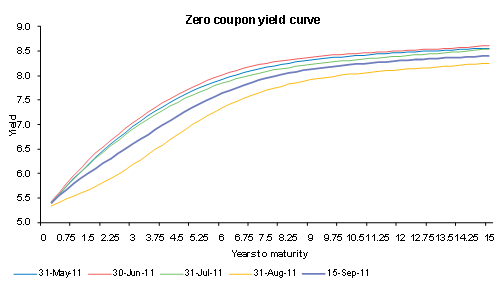
Bond Economics: Primer: Par And Zero Coupon Yield Curves The higher the coupon, the more valuable the bond, We see that the bond has a price of $100 when the coupon rate is 5.88% (roughly). Since we say that a bond that is trading with a price of $100 is trading at par, we then say that 5.88% is the 10-year par coupon yield.
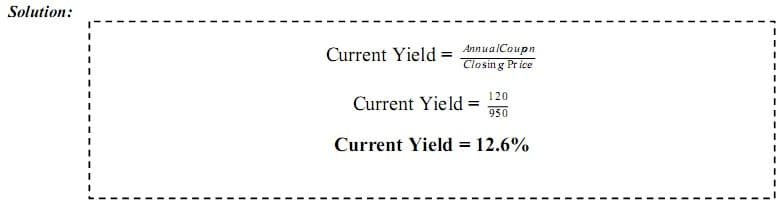
Bond Discounting I Types I Examples I Formula I Bonds Valuation
Understanding Zero Coupon Bonds - Part One - The Balance Zero coupon bonds or zeros don't make regular interest payments like other bonds do. You receive all the interest in one lump sum when the bond matures. You purchase the bond at a deep discount and redeem it a full face value when it matures. The difference is the interest that has accumulated over the years.

3.6 - Pricing a Coupon Bond as a Sum of Zero-Coupon Bonds - YouTube
Zero Coupon Bond | Investor.gov Zero coupon bonds are bonds that do not pay interest during the life of the bonds. Instead, investors buy zero coupon bonds at a deep discount from their face value, which is the amount the investor will receive when the bond "matures" or comes due. The maturity dates on zero coupon bonds are usually long-term—many don't mature for ten, fifteen, or more years.

You purchased a zero-coupon bond one year ago for | Chegg.com
What's the difference between a zero-coupon bond and a Treasury ... - Quora Zero coupon bonds does not carry interest rate.It is issued at discounted value ,less than face value .At maturity one gets face value .ZCP of face value Rs 100 issued for Rs 97.On maturity gets Rs .100. Tbills issued forRs 100 may carry interst of 3% payable along with maturity proceeds. 14 day internmediate treasury bill is issued only to Govt
Printable bond lodgement form wa - Edit, Fill Out & Download Hot Forms ...
About Discount Bonds versus Zero Coupon Bonds Zero Coupon bonds are securities issued at a discount, and they have a zero coupon rate; they pay no interest. Zero Coupon bonds generally have a Maturity Date that is more than a year and a half out from the issue date. Unlike discount bonds, Zero Coupons do take compounding into account, and are generally issued with a semi-annual compounding yield; therefore, they have a Payment Frequency equal to the standard payment frequency of semi-annual.
Long term interest rates and the rand: All explained by global risk ...
The One-Minute Guide to Zero Coupon Bonds | FINRA.org Instead of getting interest payments, with a zero you buy the bond at a discount from the face value of the bond, and are paid the face amount when the bond matures. For example, you might pay $3,500 to purchase a 20-year zero-coupon bond with a face value of $10,000. After 20 years, the issuer of the bond pays you $10,000.

What is a Zero-Coupon Bond? Definition and Meaning - Market Business News
Difference Between a Zero-Coupon CD & a Bond | Budgeting Money - The Nest Restrictions. One of the main differences between zero-coupon CDs and a bonds is in the way you buy and sell them. Although some financial services firms now offer CDs, traditionally you buy a CD directly from the issuing bank. If you sell the CD back to the bank before it matures, you will owe an interest penalty.
Zero-Coupon Bonds | AnnuityAdvantage
What is a Zero Coupon Bond? Who Should Invest? | Scripbox A coupon is an interest the bond issuer pays the bondholder. Coupon payments happen periodically from the time of issuance of the bond until its maturity. A zero coupon bond is a type of fixed income security that does not pay any interest to the bondholder. It is also known as a discount bond.
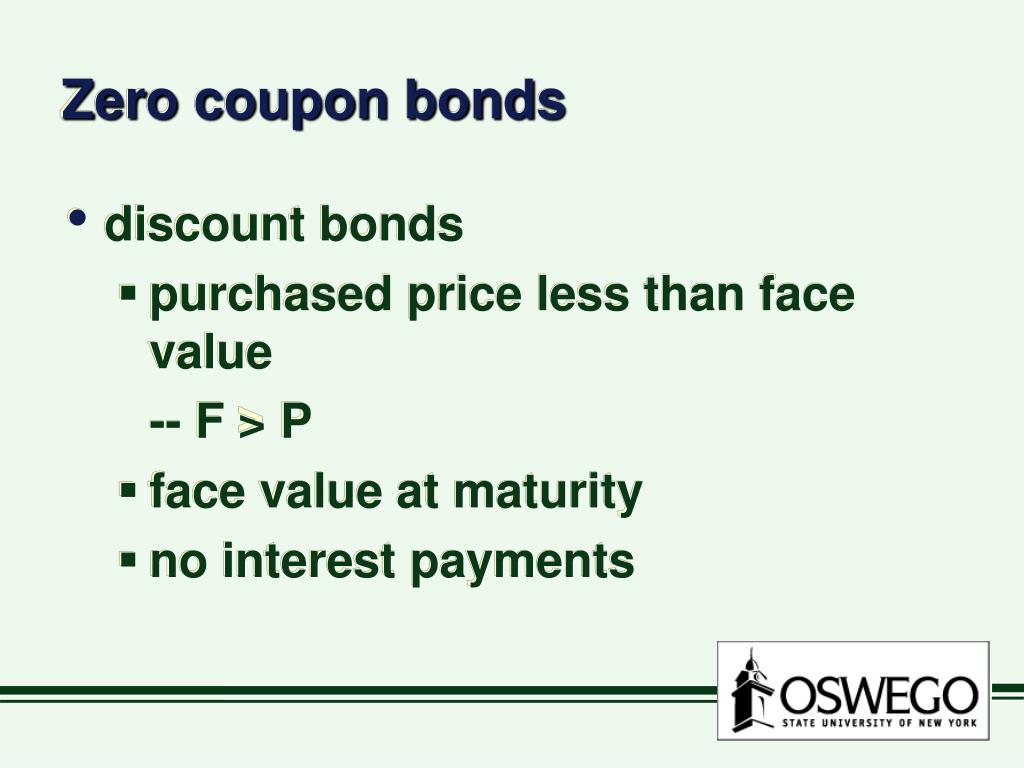
PPT - Chapter 6. Bonds, bond prices and interest rates PowerPoint ...
What is the difference between a zero-coupon bond and a regular bond? The difference between a regular bond and a zero-coupon bond is the payment of interest, otherwise known as coupons. A regular bond pays interest to bondholders, while a zero-coupon bond does not...

How are bonds priced? – Pecunica™
Discount bond vs. Zero coupon bond : personalfinance - reddit They're all colloquialisms that change with time. But yea, hes wrong. Discount means trading at a discount (less than face value), zero coupon is exactly that, no coupons (like treasuries) A discount bond is just a bond that sells/trades at a discount to par value. Your economics professor is incorrect.

Zero Coupon Bonds / السندات صفرية العائد - YouTube
Zero-Coupon Bond: Formula and Excel Calculator In contrast, for zero-coupon bonds, the difference between the face value and the bond's purchase price represents the bondholder's return. Due to the absence of coupon payments, zero-coupon bonds are purchased at steep discounts from their face value, as the next section will explain more in-depth. Zero-Coupon Bond - Bondholder Return

Price: Price Yield Curve
What is the difference between a zero-coupon bond and a regular ... - Quora The difference between a regular bond and a zero-coupon bonds, is that the former pays bondholders interest, while the latter does not issue such interest payments, otherwise known as coupons. Instead, zero-coupon bondholders merely receive the face value of the bond when it reaches maturity, while coupon paying bondholders receive both the face value, while also receiving coupons, over the life of the bond.

Accounting for Zero-Coupon Bonds
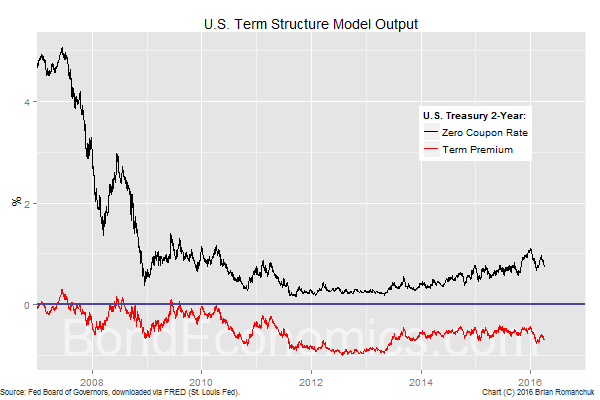
FRED Adds Term Structure Model Series - iShares 7-10 Year Treasury Bond ...

Zero Coupon Bonds - Part 5 of New Series - How to Invest... | Bonds ...
Post a Comment for "45 coupon vs zero coupon bonds"